
C57BL/6-Adgre5tm1(ADGRE5)Bcgen/Bcgen • 112968
| Product name | B-hADGRE5 mice |
|---|---|
| Catalog number | 112968 |
| Strain name | C57BL/6-Adgre5tm1(ADGRE5)Bcgen/Bcgen |
| Strain background | C57BL/6 |
| NCBI gene ID | (Human) |
| Aliases | CD97; TM7LN1 |


Gene targeting strategy for B-hADGRE5 mice. In humanized mice, exons 2-7 of mouse Adgre5 are replaced by exons 2-18 of the human ADGRE5. The 5’UTR and signal peptide of the mouse gene are retained, while the 3’UTR is human. The ADGRE5 expression is driven by endogenous mouse Adgre5 promoter, while mouse Adgre5 gene transcription and translation will be disrupted.

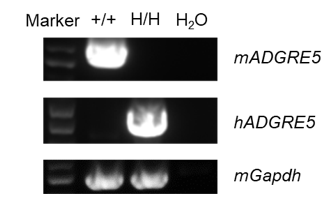
Strain specific analysis of ADGRE5 mRNA expression in wild-type C57BL/6 mice and B-hADGRE5 mice by RT-PCR. Spleen RNA were isolated from wild-type C57BL/6 mice (+/+) and homozygous B-hADGRE5 mice (H/H), then cDNA libraries were synthesized by reverse transcription, followed by PCR with mouse or human ADGRE5 primers. Mouse Adgre5 mRNA was only detectable in wild-type mice. Human ADGRE5 mRNA was exclusively detectable in homozygous B-hADGRE5 mice but not in wild-type mice.
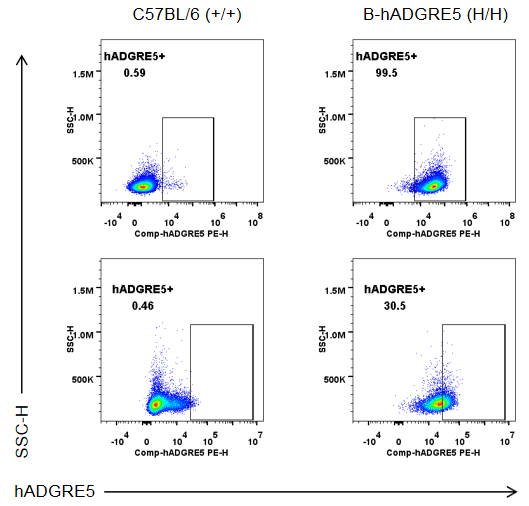
Strain specific ADGRE5 expression analysis in wild-type C57BL/6 mice and homozygous humanized B-hADGRE5 mice by flow cytometry. Splenocytes(top) and blood cells (bottom) were collected from wild-type C57BL/6 mice (+/+) and homozygous B-hADGRE5 mice (H/H) (female, 10-week-old, n=1). Protein expression was analyzed with anti-human ADGRE5 antibody (Biolegend, 336307) by flow cytometry. Human ADGRE5 was exclusively detectable in homozygous B-hADGRE5 mice, but not in wild-type C57BL/6 mice.
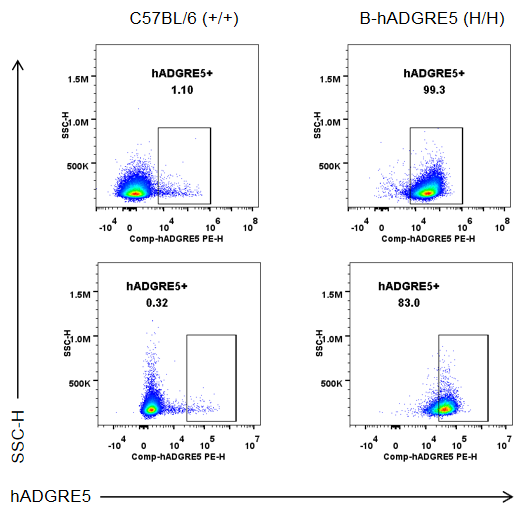
Strain specific ADGRE5 expression analysis in wild-type C57BL/6 mice and homozygous humanized B-hADGRE5 mice by flow cytometry. Splenocytes(top) and blood cells (bottom) were collected from wild-type C57BL/6 mice (+/+) and homozygous B-hADGRE5 mice (H/H) (female, 10-week-old, n=1). Protein expression was analyzed with anti-human ADGRE5 antibody (Biolegend, 336307) by flow cytometry. Human ADGRE5 was exclusively detectable in homozygous B-hADGRE5 mice, but not in wild-type C57BL/6 mice.
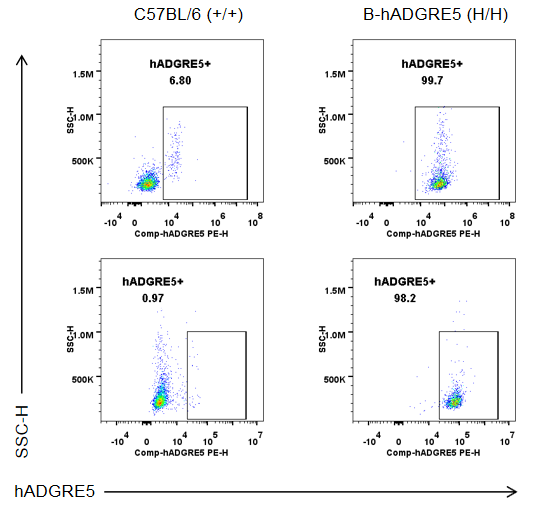
Strain specific ADGRE5 expression analysis in wild-type C57BL/6 mice and homozygous humanized B-hADGRE5 mice by flow cytometry. Splenocytes(top) and blood cells (bottom) were collected from wild-type C57BL/6 mice (+/+) and homozygous B-hADGRE5 mice (H/H) (female, 10-week-old, n=1). Protein expression was analyzed with anti-human ADGRE5 antibody (Biolegend, 336307) by flow cytometry. Human ADGRE5 was exclusively detectable in homozygous B-hADGRE5 mice, but not in wild-type C57BL/6 mice.
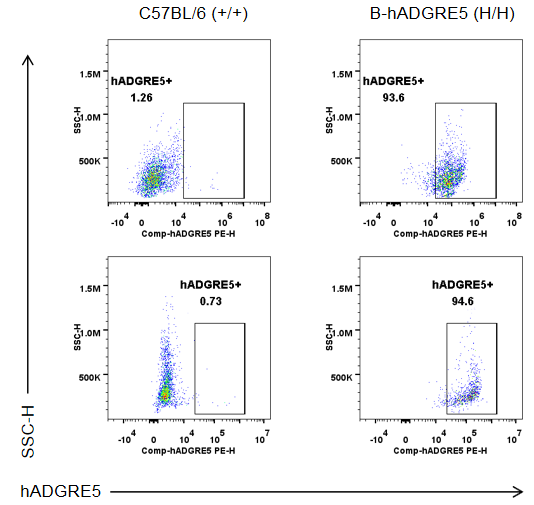
Strain specific ADGRE5 expression analysis in wild-type C57BL/6 mice and homozygous humanized B-hADGRE5 mice by flow cytometry. Splenocytes(top) and blood cells (bottom) were collected from wild-type C57BL/6 mice (+/+) and homozygous B-hADGRE5 mice (H/H) (female, 10-week-old, n=1). Protein expression was analyzed with anti-human ADGRE5 antibody (Biolegend, 336307) by flow cytometry. Human ADGRE5 was exclusively detectable in homozygous B-hADGRE5 mice, but not in wild-type C57BL/6 mice.
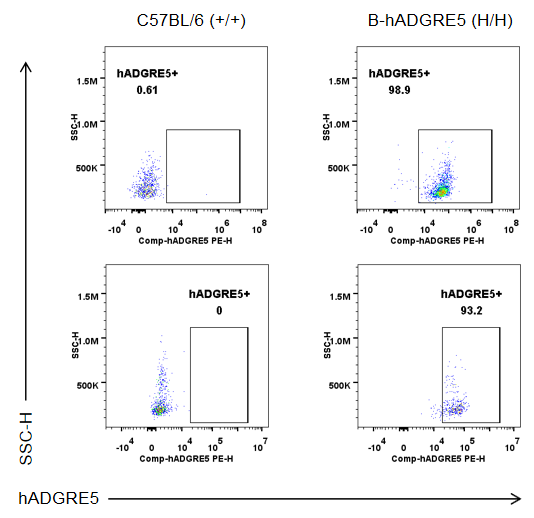
Strain specific ADGRE5 expression analysis in wild-type C57BL/6 mice and homozygous humanized B-hADGRE5 mice by flow cytometry. Splenocytes(top) and blood cells (bottom) were collected from wild-type C57BL/6 mice (+/+) and homozygous B-hADGRE5 mice (H/H) (female, 10-week-old, n=1). Protein expression was analyzed with anti-human ADGRE5 antibody (Biolegend, 336307) by flow cytometry. Human ADGRE5 was exclusively detectable in homozygous B-hADGRE5 mice, but not in wild-type C57BL/6 mice.
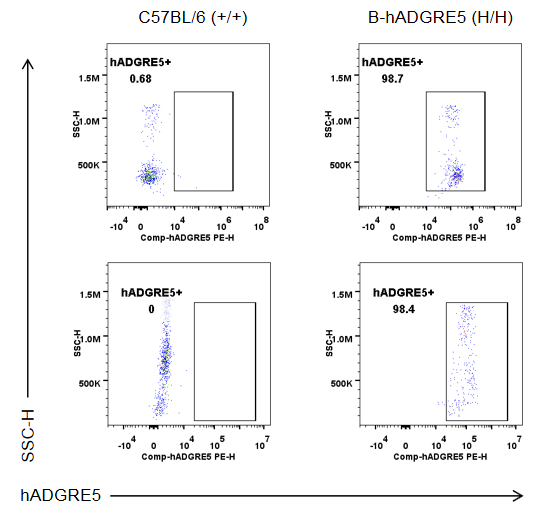
Strain specific ADGRE5 expression analysis in wild-type C57BL/6 mice and homozygous humanized B-hADGRE5 mice by flow cytometry. Splenocytes(top) and blood cells (bottom) were collected from wild-type C57BL/6 mice (+/+) and homozygous B-hADGRE5 mice (H/H) (female, 10-week-old, n=1). Protein expression was analyzed with anti-human ADGRE5 antibody (Biolegend, 336307) by flow cytometry. Human ADGRE5 was exclusively detectable in homozygous B-hADGRE5 mice, but not in wild-type C57BL/6 mice.
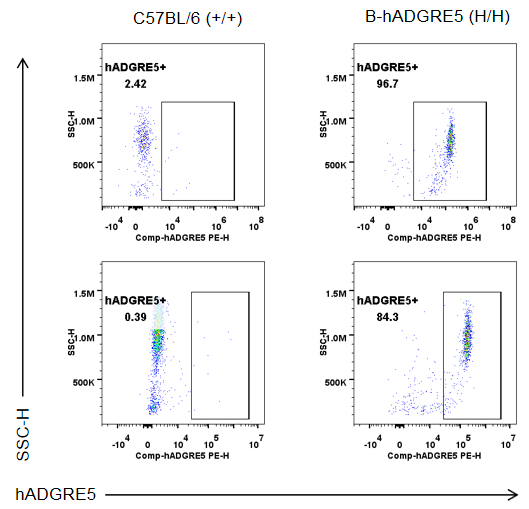
Strain specific ADGRE5 expression analysis in wild-type C57BL/6 mice and homozygous humanized B-hADGRE5 mice by flow cytometry. Splenocytes(top) and blood cells (bottom) were collected from wild-type C57BL/6 mice (+/+) and homozygous B-hADGRE5 mice (H/H) (female, 10-week-old, n=1). Protein expression was analyzed with anti-human ADGRE5 antibody (Biolegend, 336307) by flow cytometry. Human ADGRE5 was exclusively detectable in homozygous B-hADGRE5 mice, but not in wild-type C57BL/6 mice.

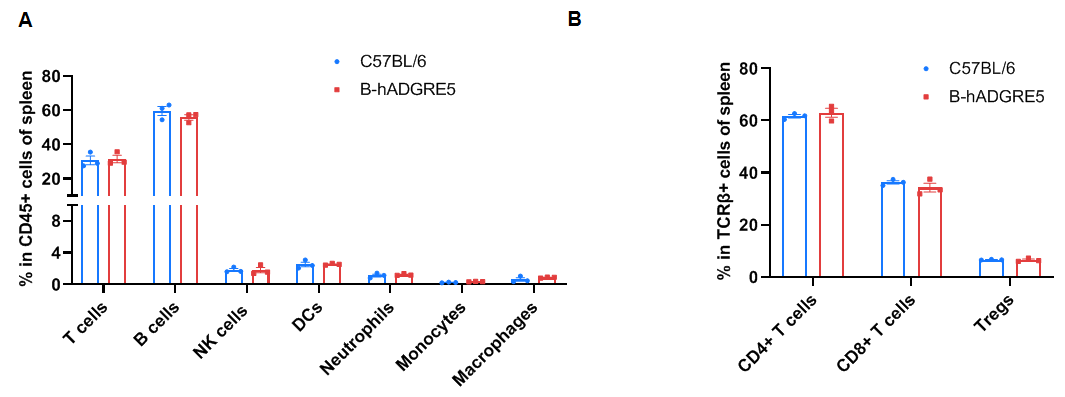
Frequency of leukocyte subpopulations in spleen by flow cytometry. Splenocytes were isolated from wild-type C57BL/6 mice (female, n=3, 6-week-old) and homozygous B-hADGRE5 mice (female, n=3, 6-week-old). A. Flow cytometry analysis of the splenocytes was performed to assess the frequency of leukocyte subpopulations. B. Frequency of T cell subpopulations. Percentages of T cells, B cells, NK cells, dendritic cells, neutrophils, monocytes, macrophages, CD4+ T cells, CD8+ T cells and Tregs in B-hADGRE5 mice were similar to those in C57BL/6 mice. Values are expressed as mean ± SEM. Significance was determined by two-way ANOVA test. *P < 0.05, **P < 0.01, ***p < 0.001.
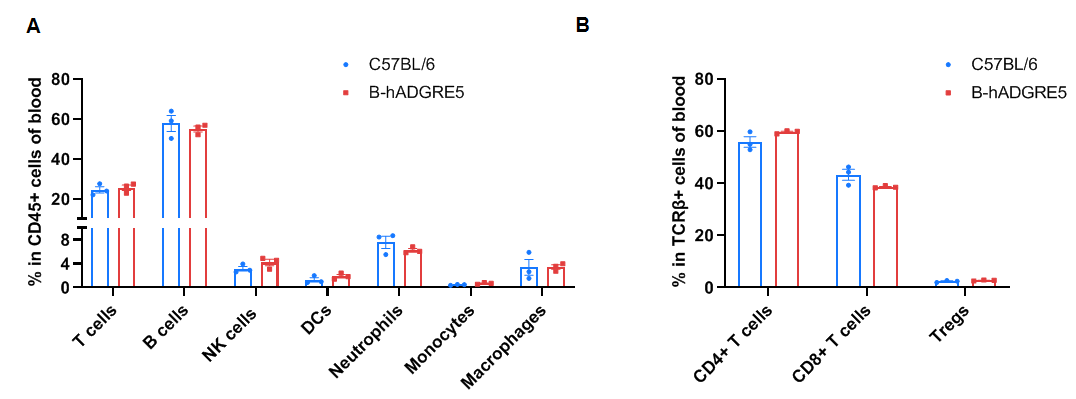
Frequency of leukocyte subpopulations in blood by flow cytometry. Blood cells were isolated from wild-type C57BL/6 mice (female, n=3, 6-week-old) and homozygous B-hADGRE5 mice (female, n=3, 6-week-old). A. Flow cytometry analysis of the blood cells was performed to assess the frequency of leukocyte subpopulations. B. Frequency of T cell subpopulations. Percentages of T cells, B cells, NK cells, dendritic cells, neutrophils, monocytes, macrophages, CD4+ T cells, CD8+ T cells and Tregs in B-hADGRE5 mice were similar to those in C57BL/6 mice. Values are expressed as mean ± SEM. Significance was determined by two-way ANOVA test. *P < 0.05, **P < 0.01, ***p < 0.001.
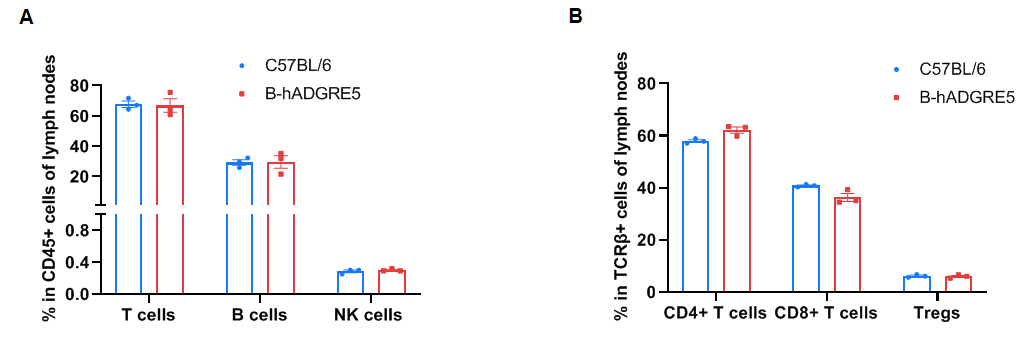
Frequency of leukocyte subpopulations in lymph nodes by flow cytometry. Lymph nodes cells were isolated from wild-type C57BL/6 mice (female, n=3, 6-week-old) and homozygous B-hADGRE5 mice (female, n=3, 6-week-old). A. Flow cytometry analysis of the lymph nodes cells was performed to assess the frequency of leukocyte subpopulations. B. Frequency of T cell subpopulations. Percentages of T cells, B cells, NK cells, CD4+ T cells, CD8+ T cells and Tregs in B-hADGRE5 mice were similar to those in C57BL/6 mice. Values are expressed as mean ± SEM. Significance was determined by two-way ANOVA test. *P < 0.05, **P < 0.01, ***p < 0.001.
